Getting up to their level

I recently read a comment on Facebook about a caregiver in an assisted living complex who mentioned that he had learned to get down to their level.  In one sense, this is accurate because you are bending down to speak with those in wheelchairs, or to assist them in some way.  But in fact, in relating to people who are in places like that is not a going down, but a lifting up.  Since Dad’s birthday anniversary was only a few days ago and I’m thinking of him and missing him so much, I wrote a little piece in tribute to our elderly and too often forgotten citizens.

I have spent more than my share of time in independent and assisted living facilities as well as skilled nursing with my parents and others. As age and disease wreak their havoc, it is tragic and extremely painful to witness. When it’s somebody whom you love it is beyond painful, it’s devastating.

I’ve been in a lot of facilities mostly in the Midwest but a few in California as well. My mother had Alzheimers and my father had Lewy Bodies Dementia. Never in my experience did I feel that I was getting down to their level. What I witnessed was a bravery in the face of constant pain, loss of privacy, dignity and independence.

I saw people who were neglected by caregivers because their family was not there to advocate for them and make sure that their needs were met. I saw people who had to eat institutional meals rather than the food they loved and enjoyed. I saw endless, lonely hour, days, weeks, months and years of mind numbing emptiness and resignation. Yet in each one I also saw courage, bravery and humor. There was a wealth of wisdom and experience, of stories and insights not found anywhere else.

Those with dementia lived in a fuzzy world of the half remembered, often distorted, sometimes fantastical world of a reality only they could see but every bit as authentic as my own. These are the true heroes.

Not by choice, but necessity they face the demons of old age steadfast and resolute. I never stooped down to their level; they buoyed me up to theirs. They inspired me and sometimes even shamed me of my pettiness, weakness and of my lack of appreciation for the blessings that I enjoy. If I could but live so bravely and die so well, I shall be proud to join their company some day.

My Ghost Story

I attended Harding College in Search, Arkansas  my freshman and sophomore years, beginning in 1966, majoring in music. The head of the music department, Dr. Moore would occasionally confide in his music theory class some of his rather unusual convictions, namely his belief in ghosts and UFO’s. He claimed first hand encounters with both.

One day he told us about a ghost that inhabited the very building in which we were sitting. Being of skeptical mind, I dismissed both.  As I remember the story, a girl jumped or fell from third story of the dormitory of a Woman’s college that was later purchased to become Harding College. She fell over the stair well and was killed when she struck the ground floor. I think we were told that she committed suicide, but I don’t remember the details of stories told fifty years ago. Anyway, as the story goes, that dormitory was eventually demolished and bricks from that building were salvaged and reused to construct the music building in use while I attended Harding. The prevailing opinion was that with the bricks came the ghost of that unfortunate girl.

I had heard the stories, but I dismissed them as flights of overactive imaginations.  Since my roommate had keys to the music building, I would sometimes go late at night to practice.   One night I was there alone, as usual.  Since I was studying clarinet privately and had to play a solo as an exam,  I decided to also record myself playing the piano accompaniment and then play the clarinet along with my own recording. I had my Wollensak reel to reel recorder all set up and was playing the grand piano in the main room on the first floor in the center of the building. There were some other classrooms, offices and studios on the first floor. The second floor was given over to practice rooms in addition to one classroom. There was a set of stairs at either end of the building leading up to the second floor. Other music students had claimed to hear a piano playing from a practice room on the second floor and some thought that they had seen the ghost of the girl who had died in the dormitory of the earlier college. These events always took place at night when the building was closed and locked.   I thought that it was nonsense. But while I was playing downstairs, I heard footsteps upstairs. I stopped, listened and continued playing, dismissing the sound as the creaking of the old building.   But then the sound footsteps began traversing the hallway that extended the length of the building. They began pretty much at one end, near the stairs and slowly proceeded toward the stairs at the other end. They were clear and deliberate and I could easily hear the progress and direction of the steps. I heard no music except for what I was playing. I did not see the ghost nor hear anything but the footsteps, but as the sound of the footfalls began descending the steps, I hastily grabbed my music, clarinet and tape recorder, and fled the building. That put an end to my late night practicing and recording sessions and I became a reluctant believer.

If you want to more about the ghost, check out the links below:

http://www.prairieghosts.com/harding.html

http://www.arkansasonline.com/news/2007/oct/07/ghost-stories-white-county-galloway-gerti-20071007/

Pattie Cobb – The Queen of Campus

https://seeksghosts.blogspot.com/2011/09/ghost-of-galloway.html

http://www.argenweb.net/white/wchs/The_Galloway_Ghost_files/The_Galloway_Ghost_1998.html

http://littlerock.about.com/cs/urbanlegends/a/aaghosts_4.htm

http://thelink.harding.edu/the-bison/2015/11/05/five-haunted-locations-in-arkansas/


It’s Adam’s fault

If you are guilty of something, follow these steps. First, don’t volunteer the information. Step 2: If you are accused, deny your guilt. Step 3: If there is a witness, continue to deny and then try to discredit the witness. Step 4: If that doesn’t work, then say that you were misunderstood, misquoted or quoted out of context. Step 5: If that fails, then point out that A: everybody else is doing it or B: somebody else is worse or C: divert attention by uncovering an even greater scandal. Step 6: gather your family around you, admit your guilt, ask for forgiveness and tearfully promise never to do it again. And as a last resort: Step Seven: Resign and disappear to write your memoirs and get rich on a book deal. Step Eight: Hit the lecture circuit and make even more money.

It goes all the way back to the Garden of Eden. God said, “I’ve given you a whole garden full of good things to eat. JUST DON’T TOUCH THE COOKIES! Next thing you know, Eve spies the cookie tree. They look yummy! But God said, “NO COOKIES!” Then the snake comes along and says, “That’s fake news! Eat the cookies. They are good for you! So she eats a cookie and all of a sudden, Adam is looking very desirable as well. Eve says, “Hey there big boy. Wanna have a cookie? They taste really good and after you eat one, you’re gonna get a really nice surprise!” She starts touching him and he begins to feel REALLY GOOD, so he eats a cookie. It tastes really good and Eve…”WOW! I never noticed before. We’re naked! Better go hide before God catches us.” That was a real buzz kill. So along comes God. They know that they are guilty. That’s why they are hiding. God says, “Why are you hiding?” “Cuz we’re naked.” “Who told you?” ” We ate the cookie and we found out that we were naked.” “Why did you eat the cookie? I told you not to.” “The snake made me eat it.” “Don’t you know better than to trust a talking snake?” “Adam, what’s your story?” “Well, that woman thing that YOU gave me, she made me eat the cookie and boy, howdy, that’s not ALL I discovered! But I wouldn’t na done it but when I saw her naked and all, well, I just don’t know what came over me. It’s your fault for giving her to me. She’s defective.” So God tells the snake that there’s no such thing as alternate truth. “You’re a liar and you’re gonna pay for it.” “And Eve, no more romping around naked in the garden. You’ve violated the terms of your lease. Out you go, and by the way, those games you and Adam have been playing since you found out you were naked? Guess what?  You’re gonna get fat and miserable and after a while, you’re going to have company. Another little Adam is going to pop out and it’s going to hurt like you wouldn’t believe. You’re going to have to feed it and take care of it. And that’s not all. He’s going to be a little hellion. Boy are you going to be sorry!” “Now, for you, Adam…how could you be so gullible? I give you all this cool stuff and there was only one catch. NO COOKIES! So what do you do? Head straight for the cookies. And then try to blame ME. Well, tell you what. You had a good gig going here for a while, but you had to go and ruin it. Okay, tell you what…from now on, well, first of all, I’m throwing you out of the garden. And there’s no more easy pickin’s. You’re on your own for food. Grow it yourself.” “And I’ll be keeping an eye on you. Don’t forget it.”

Now, go back to the beginning and you’ll see that Adam and Eve invented Steps 1-5. They couldn’t do step 6 because they didn’t have a family yet. Step 7 wasn’t possible because the printing press hadn’t been invented until much later. And Step 8 had to wait until they had somebody to talk to.  But the basics are all there, way back in the Garden and it’s still going on today, especially in Washington D.C.

Childhood memories…the station

Feb. 27, 2017. 2:10 am.

After 2 am and I can’t sleep.  Started thinking about Grandpa Johnson’s Sinclair station.  It was located on Hazel St. on the NW corner of W. Madison.  To the south was the YWCA, across the  street was the library and diagonally was the parking lot for the post office vehicles. The station is gone now.  The library as now a war museum.  The post office vehicles all bought their gas from Grandpa.  He also rented moving trucks.  He was the first one in Danville to offer that service.  Sometimes they would let me pump gas.  That was a big thrill for me.  My brother, John and I liked to stomp on the black rubber hose that ran from the station out to the drive where the gas pumps were.  When a car ran over it, the hose would trigger a bell inside the station to signal that there was a customer.  In those days, the driver never pumped the gas; the station attendant did that.  And while the gas was running, the attendant would check the tire pressure and oil level and clean the windshield.  All of that was part of the service when gas was purchased.  John and I discovered that the bell could be triggered by stamping on the hose.  Great fun!

Then there were the peanut machines.  One machine had peanuts and the other had cashews.  I don’t remember the price but I think it was ten cents for a handful of peanuts and twenty-five cents for cashews, but I’m not sure.  Occasionally I had enough money to splurge on a handful of peanuts but never for the cashews.  There were candy bars too.  I liked the PayDay best.  Speaking of candy bars, Mom’s favorite was Snickers but Dad preferred Milky Way because nuts would get under his false teeth. And he had false teeth from early adulthood.  Supposedly he had pyria that was so severe that all his teeth were pulled.

Anyway, speaking of vending machines, there were two more at the station.  One was the pop machine.  It had multiple slots, each one loaded with a different flavor.  The bottles were suspended by their necks.  I don’t remember all the flavors. My favorite was Chockola, a chocolate drink, but orange and grape were good too.  I also liked Squirt.  There was a cola but I don’t remember whether it was Coke or Pepsi.  The bottles were in wooden cases with probably 24 bottles in each case which was divided into a 4 X 6 matrix.  Sometimes I would be allowed to load the pop machine.  So the way it worked was you would raise the lid, identify your choice of soda by the bottle cap, then slide the bottle down the slot to the end, then up and into the dispensing mechanism which was a sort of hinged metal piece that would allow a bottle to be pulled up and out once a quarter was put into the slot.  You would hear the money drop into the coin box and the metal hinged piece would ratchet upward.  Now the other vending machine was a mystery.  It was mounted on the wall beside the bathroom door, inside the bathroom.  On the front of the machine was written that whatever the contents were, which was not stipulated were for the prevention of disease.  Now a bathroom never struck me as a disease free zone which heightened the mystery.  I wanted to put in a quarter, turn the knob and see what popped out, but I was afraid that somebody would hear the noise of the machine and I would have some explaining to do.  I must have thought that it was some secret reserved for adults because I never asked anybody about it.  By the time I learned about such things the gas station and with it, the mystery machine were long gone.

Now there were two other employees at the station along with my grandfather.  One was named Jim and it was evident even to me as a child that he had a serious drinking problem but he was friendly enough to me and since Grandpa was far from a teetotaler himself, I guess they got along just fine.  Jim had a little trick that he would sometimes pull.  He would short stick the oil dipstick.  The way that works is that to check the oil, first you pull out the dipstick and wipe it off, then reinsert it, pull it back out and read the oil level on the stick.  But if you don’t push it all the way back in, you can make it appear that the oil is low and thereby sell a quart of oil along with the gas.  That doesn’t mean that you have to pour all the oil into the engine.  You just go through the motions.  I don’t think that my grandfather approved of the practice, but I’m not sure that he actually forbad it either.  There was another man too whose name I don’t remember.  Turns out that the cash that he put into the register stuck to his fingers and ended up in his pocket.  He embezzled a lot of money from Grandpa and when that came to light, he disappeared.  So far as I know, no legal actions were taken.  Then there was Clarence, a black man.  We loved him.  One of the bays in the station was equipped with a car wash machine.  It consisted of two vertical and one horizontal metal device that could be rolled forward and backward on tracks on the floor.  It was equipped with spray nozzles that would soak the vehicle with water.  It was an early forerunner of the car wash machines that you see today.  All it did was spray water.  Soap was applied with a bucket and brush or cloth and the vehicle would be dried by chamois.  There was also a wringer to run the chamois through and squeeze out the water.

I was fascinated with the car lift.  It consisted of two steel runners spaced the correct distance to line up with an automobile’s wheels.  A car could be driven onto the runners and then a large hydraulic cylinder would come up from the floor, lifting the runners, car and all up into the air.  As it raised up above the floor, two metal plates would flip up behind the rear wheels to prevent the car from rolling backwards off the device.  Then the mechanic would wheel a small barrel equipped with a large funnel under the car’s crankcase to drain the oil.

They also had a dynamic wheel balancer that would spin the wheel really fast and mark where the wheel weights needed to go to balance the wheel.  There was also a machine that would break the tire off the rim in order to take out the inner tube and patch a hole.  And, of course, a specially designed tank to submerge a tire to check for leaks.  There seemed to be no end to gadgets and things to play with and surprisingly, nobody seemed to mind that my brother and I play with everything.  There was also a very cool adding machine that had ten rows of buttons numbered from zero to nine.  A number would be entered by mashing down the appropriate buttons for the first number and operating a lever on the right hand side to enter it.  Then you would press a function key to add or subtract the next number, then enter the next number and pull the lever, and so forth.  Each time the handle was pulled, the number would print on a strip of paper called a tape.  It was noisy, tactile and magical.

Finally, there was a radio that was always tuned to a ball game if any were being broadcast from Danville, Chicago or Indianapolis which were the limits of the reception range.  So the smell of gasoline, oil and grease along with tires, belts and car engines bring back those memories to this day.

There are three more things that come to mind, dogs, the jeep and plastic letters.  In the 1950’s, plastics were not as pervasive as they are today.  In fact, many were being developed at that time.  At the station Grandpa had plastic letters that would stick to windows.  He would use them to advertise specials or display messages.  I loved playing with them.  The idea that they would stick to glass and then could be peeled off to be used again was amazing.

Lady was an old Dalmatian who lived at the station.  She mostly just laid around.  Because there was a lot of grease and oil around, she tended to pick up her environment.  But everybody loved her.  Butch was one of her pups.  He was at the station too, but much more active than Lady.  They were a part of the life of the station.  I can remember Butch jumping into the jeep when it was taken out on a service call.  The jeep was a WWII surplus, no frills vehicle.  The windshield wiper on the driver’s side was motorized.  It ran off the engine vacuum.  The wiper on the passenger side was manual.  A knob stuck through into the cabin and was operated by hand.  The passenger compartment was enclosed by canvas, but there were no doors which made for some pretty brisk rides in the winter.  In the back of the jeep, you would find chains, jumpers and tools to change tires.  I think that it also had an air compressor.  No seat belts, of course.

The memories of long ago when the world was more innocent and life was simpler and slower.  And as a child, unburdened by the worries and cares of adulthood, it was a great time to be alive.

It’s 4 a.m., so I’ll try to find the sandman again.

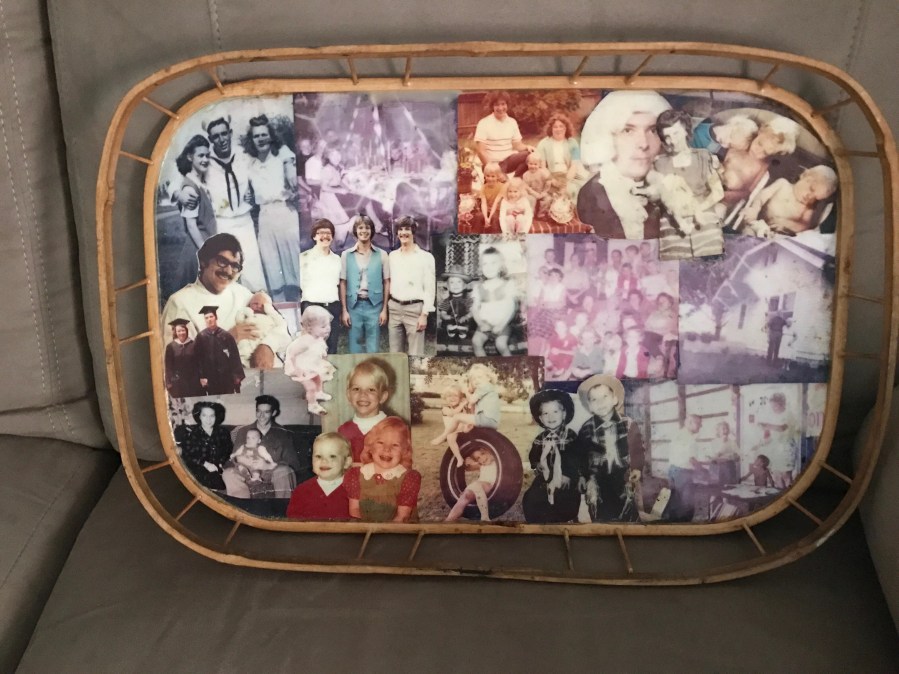
my breakfast tray

Years ago my cousin Mary Ann made this tray and gave it to me for Christmas.  Most of the people in those pictures are no longer with us in body, but every person is with me in spirit.  They influenced and in the case of my immediate family, molded my life.  I miss my aunt and uncles and especially my parents so very much.  I look at these pictures of them in their own youthful vitality, optimism, innocence and remember them in their maturity–wise, loving, caring, noble in their own way.

I see myself as a baby, a little boy, a young man and review my life’s experiences and am filled with gratitude and humility for the numberless blessings that I have enjoyed.  Grandpa Johnson sometimes mused, “For every smile there are one hundred tears.”  I didn’t understand that when I was young.  Now I do.  But with the tears came wisdom, understanding, compassion and sometimes with resolutions to become somehow better.  Some tears were of joy — others, sorrow.  There have been many wasted tears of regret because regret only binds one to the past and the past cannot be changed.  It only teaches us how to better live in the present if we have the  wisdom to learn and the humility to change.  Blessings of a loving family, health, shelter, food, friends, safety, electricity, a means of transportation, music, books, the peace that comes from my faith in Jesus, education, a declining  but still functioning brain, a special person to share my life with and endless others.  I am thankful.

Now one of my children has passed the four decade mark and the other two are fast approaching as I see three score and ten just around the corner.  Their pictures remind me of how fleeting and unpredictable life is.  They have grown up to be amazing adults who fill me with joy and pride.  I am thankful to my wife and forever grateful for the years we spent together and for her time and devotion to our family.

Today, as I eat my breakfast on my tray of memories, I realize that it may be the best Christmas present ever.  I eat breakfast with my family, loved ones spread from here to eternity, but present in my heart, in my thoughts and in my soul.

Just thinking…Christmas Eve 2016

Just thinking…Christmas Eve 2016

Remember the popular 60’s song, “It Was a Very Good Year”?  Well, 2016 wasn’t one of them.  As of this writing, in the U.S. alone, 3,233,871 people have died ranging from two who died while playing Pokeman 2 and 1,093,982 lives were lost to abortion.  There were 11, 514 gun deaths, 24 domestic mass shootings, 49 murders by Islamic terrorists and 6000 who died in accidents caused by texting while driving.  For more statistics, go to http://www.romans322.com/daily-death-rate-statistics.php.  Much has been said about celebrities who died in 2016.  One list includes 163 names ranging in age from 27 years old to 99 years old.  (http://wgntv.com/2016/12/28/full-list-of-celebrity-deaths-in-2016/)  Only two touched me personally, but many among my friends, family and acquaintances lost loved ones in this past year.  In sixty-eight years, many people who were influential in my life are beyond the reach of a phone call, personal visit or an email.  Whatever I am today was molded by those people.  I miss their encouragement, their wisdom, their humor, their love, the sounds, touch and smell of them.  

I have been greatly discouraged by recent events.  I believe that our country is in great peril.  This year has witnessed the death of truth.  It has been the year of irrationality.  We have seen, in America, the greatest ugliness and decline in civility in my lifetime. The divisiveness, rejection of facts, a pervasiveness of paranoia and fear, the worship of riches, the rise of materialism and the decline of humanity are glamorized in media and common discourse.  Everywhere you look you find wars, inhumanity practiced on a grand scale, and a callous insensitivity even among Christians.  I hear Cain’s cynical voice echoing down through history asking, “Am I my brother’s keeper?”.  

More than ever, we are indeed our brother’s keeper and our brothers are not just those who are blood relation, not just our family, not just the people we like, not just those who look, speak, act and think like us, but the world.  As Americans, we lost sight of that in 2016.  I’m concerned.  I’m upset and indignant.  I’m discouraged.  I’m angry at God, the church, our government, the American people, our media, my family, my friends and at myself. “Make America Great Again” is one of the most egregious slogans ever coined.  Trump is a demagogue, a tyrant, a bully, a world class liar and deceiver.  

Even so, 2016 wasn’t ALL bad.  America today is better than it was eight years ago by almost every economic index you can name.  In many ways it’s better than it has ever been…period.  After over a year, I finally was able to begin playing trumpet and other wind instruments again once my gums healed from the botched tooth extractions.  I’m so grateful for that but also grateful for my alternative musical experiences that I had as a result.  I’ve enjoyed another year of wonderful friendships.  Alberto was able to finally go back to Costa Rica to visit with his family and friends there and in March of 2017 we plan to be there to celebrate his 50th birthday.  Though we have been seeing each other since 2004, we finally made it official last year and celebrated our one year anniversary in August. I went back to Illinois for my 50 year class reunion in October and had a great time visiting with some of the Danville and Indiana relatives plus seeing classmates I hadn’t seen in 50 years.

I’m grateful for those who are still in my life — my grandchildren, children, aunts and uncles, cousins, numerous friends and associates, Lynnette, Alberto and a long list of others dear to me.  I go forward into 2017 knowing that some of those may not see another Christmas.  Knowing that the names on that short list may even include my own, I want to live in this coming year in a thoughtful, reflective, meaningful way.  I want to be silly and frivolous and I want to be caring, merciful, generous and positive.  In the book of Ephesians, the Apostle Paul wrote extensively about the sort of life that we should live.  Here are some of the things that he listed:

I therefore, the prisoner in the Lord, beseech you to walk worthily of the calling wherewith ye were called

• with all lowliness and meekness, with longsuffering

• forbearing one another in love; 

• giving diligence to keep the unity of the Spirit in the bond of peace. 

• be renewed in the spirit of your mind

• put on the new man, that after God hath been created in righteousness and holiness of truth

• Look therefore carefully how ye walk, not as unwise, but as wise;

• redeeming the time, because the days are evil

• Wherefore be ye not foolish, but understand what the will of the Lord is.

• And be not drunken with wine, wherein is riot, but be filled with the Spirit;

• speaking one to another in psalms and hymns and spiritual songs, singing and making melody with your heart to the Lord; 

• giving thanks always for all things in the name of our Lord Jesus Christ to God, even the Father

• subjecting yourselves one to another in the fear of Christ.

Well, that’s a lot to live up to!  But let’s say that you aren’t a Christian, or a believer of any sort.  Let’s say that you aren’t in tune with your spiritual nature or that you renounce it’s very existence.  That list is still a recipe for successful living.  

I pray for a great awakening in 2017, a return to reason, to truth, to facts, to reality.  The problem is not one of economics; it’s a spiritual blindness.  It’s a lack of love and consideration, it’s one of honesty, of morality, of ethics. It’s one of decency.  May we, as Americans and as people of the world hold up those values that make us, not richer, but better brothers and sisters, better neighbors, better citizens, better human beings.

I’m tired

I’m tired of everybody telling me how I should think and how I should talk–of those people who are “oh so smart” with their education and worldly ways, thinking they are better than us hard working folks.  Well, we used to be hard working.  Now we are hardly working ‘cuz our jobs are bein’ done by brown children thousands of miles away being paid next to nothin’ leaving us with next to nothin’ as well.  And what jobs are left are taken by the Mexicans swarming across our unprotected borders like rats fleeing a sinking ship, who will work for beans.  Meanwhile, those godless empty suits with a flag pin on the lapel and women in pants suits in Washington sit in their fine offices diddling their congressional aids, taking bribes from lobbyists, getting the best free medical care in the country, living off the fat of the land and getting well paid to do absolutely nothing for us poor saps trying to scratch out a living in the real world.  Hello! America to Washington.  Is anybody listening?  We’re drowning out here!

Tell you what.  Your style of government ain’t workin’ for me.  I’m fed up. I’m gonna throw your self righteous, do-nothing asses out.  What we need is a strong man.  We need somebody who’s gonna kick ass and take names.  Somebody who’s gonna get things done.  Somebody not afraid to bend or even break some rules.  It’s time to push in some faces, to take back some territory, to flex some muscle, to show the world who’s boss.  Everybody knows that we have the most powerful military in the world.  Let’s use it to impose democracy and peace.  It’s time to stamp out ISIS and put an end to all this Islamish bullshit and bring God’s rule to the world.

Now everybody knows that you have to break a few eggs to make an omelette.  We need a tyrant to get the job done. Hillary is too tied to the system to do it.  We need somebody unencumbered by democracy, by rules and tradition, a real man who lies with impunity, who has elevated character assassination to a high art.  We need somebody with the personality of a sociopath, somebody who’s personal gain runs parallel to the benefit of us right thinking people.  We need a person who disdains women and virtually anybody who is not white and rich.  We want somebody who’s only measures of success are wealth and adulation.

Throughout history, in times is crisis, just such  leaders have always risen to answer the need — Alexander the Great, Asoka, Julius Caesar, Napoleon, Hitler, Meo Zedong, Gengis Kahn, Stalin, Castro, Putin, to name but a few.  I believe that another has answered to call in our hour of need.  Casting aside the chains of our constitution, the constraints of congress, the encumbrances of law, unrestrained by reason, truth or counsel but guided by his own sense of megalomania, he will lead our country triumphantly to his own vision of greatness.  And the lion and the lamb shall lie down together, and a little child shall lead them.

And his name shall be called…

T H E   D O N A L D

Thoughts on the day of the Orlando massacre


My heart is breaking as I hear stories of survivors in Orlando and descriptions of the incident.  I wipe away tears as I write.  My thoughts are spinning as I consider what’s going on in our world. I’m looking for the big picture, the unifying structure that explains everything. Every time some horrible thing happens, I try to figure out why it happened.  What were the motivating and contributing forces that combined to give it birth?

I have a deep, insatiable need to understand things, to put them in context, to know why things happen the way they do.  I have difficulty accepting things just because somebody says so.  I find discrete facts to be boring. It’s not enough just to know and accept something. I need to know how facts relate to each other and why things work the way they do. Otherwise, facts are meaningless.

It there a way to make sense of mass shootings?  Is there some way to prevent them?  Let’s examine some traditional paradigms.

Religion once defined truth and was it’s arbiter.  But religious leaders, subject to the vices and weakness of all humanity failed in that task.  As a result, many have become disillusioned and discard religion altogether.  Inestimable good has been done in the name of religion, but also much evil.

Philosophers from ancient times to the present have attempted to use reason to discover and understand truth. Of the endless systems of thought devised by philosophers, each is intelligible only to those who devote their lives to defining that system. But even to them truth remains illusive. Each system is unintelligible to the layman. Therefore, the mass of humanity outside those esoteric and recondite bastions of introspection finds little of practical value in them.

In this age of hubris and enlightenment, Science has claimed to be the holder and protector of truth. It has the advantage of being something tangible. Religion and philosophy are abstract, intangible and difficult to grasp. Being flesh and blood, we grasp what we can see. Cause and effect are readily understood and easily demonstrated. Therefore, having rejected religion and having little use for the mental gymnastics of philosophy, many turn to science for answers. It becomes their god.  But it too fails us. It deals with the material reality but is of no use in the immaterial reality.

A bridge between philosophy and science, humanism rose to prominence in the eighteenth and nineteenth centuries and is subscribed to by many intellectuals today. There are many variations within humanism but they hold in common the belief that humanity is at the center of everything.  Critical thinking and evidence are all that are needed to derive an ever upward evolution of the human species toward perfection. Superstition, religious dogma, mysticism and the metaphysical are discarded.  For them, the only reality is that which can be tested and measured.

What IS reality?  Are we just actors in some cosmic play being manipulated by a master puppeteer beyond our comprehension?  Speculations about multi-universes, metaphysics, aliens, multiple dimensions and other esoteric concepts make us question what is real.  Advanced technologies lead us to places where reality and imagination become indistinguishable.  We live in a time where everything is questioned and where many of the confident answers of yesterday fall inadequate. Materialism is our flesh and blood reality.  But what of love, of our quest for meaning, of our hunger for connection to something beyond ourselves, of our innate sense of right and wrong, of altruism?  Why does every culture seek understanding beyond themselves that takes the immaterial form of a god?  This is the realm of metaphysics.  Science cannot go there.  It is the other part of reality.

I’ve long been fascinated by litmus paper.  I first leaned about it when I got a chemistry set as a child.  Dip it in a liquid and it changes color indicating the strength of an acid or base liquid.   Called the “litmus test”,  it becomes a metaphor for something (such as an opinion about a political or moral issue) that is used to make a judgment about whether someone or something is acceptable.  When we had a moral question, once we turned to a priest, imam, guru or other religious leader who supplied the answer.  That worked so long as we lived in homogeneous and isolated societies.  Today we have instant access to the entire world of thought, custom, belief and practice.  Traditions and customs come into conflict within our heterogeneous world.  If only we could apply a litmus test to the things that we hear, read and observe, we could determine “THE” truth.

Today, with Internet and satellite communication we have instant access to what’s going on in the world and the ability to dialogue with almost any person on the planet.  Information is difficult to verify because sources are no longer accountable to standards of truth or morality.  There is a constant clash among religions, cultures, traditions and philosophies each claiming superiority and aspiring to dominance and control.

What do we see in the Orlando massacre?  A clash of belief, culture, survival and meaning. It is a subset of the world stage where the natural state of humanity is to seek of power which is measured by money and control and pride.  Control includes territory, possessions, dominance over the thoughts and actions of others and vengeance.  Pride encompasses ego, survival, self-justification, selfishness, greed and identity.   So it looks something like this:

POWER

-Money

*Territory

*Possessions

-Control

*Dominance over thoughts and actions of others

*Vengeance

-Pride

*Ego

*Survival

*Self justification

*Selfishness

*Greed

*Identity

~Belief

~Culture

~Meaning

So what is the answer?  No single answer is sufficient to address the complexity of the problems that we face.  Some might say, “Jesus” or “Muhammad” or some other figure but those answers by themselves are meaningless.  It needs to be much more granular than that.  Power is the ultimate selfishness.

The Bible says that the love of money is the root of all evil—not money itself, but the love of money.  Money itself can represent pride, or compassion, survival or luxury.  The issue is how money is used and how it is regarded.  If it is a means to a righteous end, then it is a blessing. If it is used to add enjoyment to life, then it can also be a blessing. If it is used for purely selfish ends, then it is evil. There are matters of degree, of course and each person must honestly and deliberately weigh how he or she manages money.  But if one does not use a portion of his or her discretionary money to help others, then some self reflection is in order.

Control is a virtue if used for altruistic ends.  If it is used to deprive others of their free will, or pump up one’s self-esteem, then it is evil.  There is no place whatsoever for vengeance.  It only perpetuates and escalates wrong.  Vengeance is the author of much of the world’s unrest.  Though very difficult, forgiveness is the only answer if one is to have peace in the world and in one’s heart.

Finally, we come to pride, the most difficult of all.  Ego, the survival instinct, self-justification, selfishness and greed are pretty much self explanatory.  But let’s expand upon identity.  Our concept of who we are and how we fit in with the rest of our contemporaries is essential to our mental health and stability.  It is the cohesive force that governs our behaviors, attitudes, thoughts and inner sense of well being.  There are many markers of identity including gender, sexual constitution, physical characteristics and DNA, intelligence, aptitudes, talents and life experience.  One’s family and culture are powerful influences.  One’s socio-economic station also plays a role.  There is an overlay of tradition, societal expectations and norms.  In addition there is a belief system that is handed down from parent to child.  As children become adults, they may modify or reject some family traditions and cultural values.  They will almost always examine and challenge the belief system with which they were raised. Depending upon cultural and parental pressure, conformity may be a requirement for acceptance.  Certain personality types will resist conformity and others will easily accept it.  All of these factors make up one’s identity.

As adults, we must take responsibility for managing our pride.  Humility and generosity are effective antidotes for pride.  With respect to identity, it is highly individual.  One’s beliefs are strong and important.  One’s beliefs can and should be shared, discussed, even debated, but never compelled.  Those who hold other beliefs must must be respected and accepted.  One’s culture should be appreciated, even celebrated, and above all, respected by others.  One’s beliefs and culture give their identity meaning.  We must find ways to co-exist by respecting and accepting our differences.  Promote understanding!  Pray for the families and everyone effected by this tragedy.  That includes the killer’s family, the evil cancer that is ISIL/ISIS, for the angry, disaffected, hopeless men and women who fall prey to their message, for Muslims, Christians, Atheists and all who place their hope in something beyond themselves.  May we find understanding, forgiveness and peace.  And beyond prayer, may we all examine ourselves and pursue peace and goodwill in ourselves and toward others.

Thoughts on gay pride festivals

It’s summer and Pride is in the air.  The earliest gay pride festival in Southern California is Long Beach Pride in May.  I remember writing about my first Pride experience some years ago, maybe 2002. I didn’t see the parade because it is always scheduled on a Sunday morning which conflicts to my commitment to worship. But I did visit the Long Beach Pride event. I wrote a response online and my views remain basically the same today. Even then, as now, the concept of Gay Pride seemed to be lost in an emphasis upon hyper sexuality, drunkenness, exhibitionism and what seemed to me to be the experimental fringe of what the gay community is about. Unfortunately those are the very things that monopolize the attention of the media and which create the stereotypes of what defines being gay or what has become the LGBTQQIAA alphabet soup.

Most of us are not young, hung, hirsute (or smooth as you prefer), built like Greek gods, covered with piercings and tattoos and high on some substance or another.  Most of us are not hedonists, or … insert fetish here ______. Most of us are not perfectly coiffed, dressed according to the latest trends, depillitated, well appointed financially and socially. Many of us are partnered for years, hold down jobs and have families. Most of us are just average human beings whose actions and appearance are pretty much indistinguishable from everybody else.

Gay Pride festivals make little or no reference to gay history, to those who sacrificed to bring us to the level of acceptance and respect that we enjoy today. There is little to solicit involvement in political, social or humanitarian causes. There is little or no reaching out to the un-gay community. They remain largely very self centered.

I believe that the GAY Pride events should be reminders us of and celebrations of our history and the advances that have been made. They should be places to encourage involvement in worthy causes in our community and outside our community. They should focus upon building bridges rather than shocking the straight community with outrageous behaviors and reinforcing stereotypes. They need to reach out and affirm those who are questioning their identity and place in the world. They need to offer support and resources to those who have been hurt and even abandoned by their family, friends, church and social circle, who have been bullied or humiliated in school and the workplace. Those who are “different” should find a place of safety and acceptance, where they can lower their defenses, their protective shields and just be unapologetically themselves and discover that there are others just like them.  These should be the themes and objectives of Pride.

Internal homophobia is real, alive and pervasive in our culture as are drug and alcohol abuse. Self destructive behavior is common in our community. Pride events are places where these things should be acknowledged and talked about.  Again, resources should be available there to help people address their own issues.

There is much to celebrate and there is much left to do. We should use these events to remind our community and the community at large that we are indeed proud of our accomplishments, individually and collectively.  These should be enumerated, and we should rejoice in them.  But the work is not done and pride is only one component.  Let’s use these events to talk about acceptance–first inside our own skin and second, by everyone else. It’s about breaking the bondage of self hatred, of feeling like you are a freak and deserving of all the hatred, cruel jokes, abandonment that too often define the lives of those of us who don’t or can’t conform to other people’s expectations and societal norms. When those chains are cast off, it’s not just pride that we celebrate, but exaltation and joy of being simply ourselves.

Is boycotting these events because they fail to represent some group or fall short of the ideals to which we subscribe an effective tactic? That seems to be counterproductive. You don’t win a game by refusing to play. You don’t resolve conflict by denying it exists. If you feel passionate about something, you get involved. Roll up your sleeves, open your wallets, open your mouths, give of your time and talents and advocate for what you feel is important. By getting active in the planning and execution of these events, you are in a position to influence the end result.  If you see a Pride event as a vehicle to bring visibility to whatever is most important to you, then invest yourself in it.

What if…

Everyone has regrets. Life is an unending series of choices.  If you could go back and change one decision that you made in the past, what would it be?

That catch is that whatever you change, even something so insignificant as choosing a different pair of socks to wear on a particular day has the potential to change everything that follows, not only for your self, but for the universe.  It is fallacious to assume that our future will be exactly the same with the exception of that one thing.  The possible variations are infinite.  Take the sock example.  You choose to wear the green paisley socks instead of the solid black ones.  A person at Starbucks where you always stop for a latte notices and comments upon your socks.  That opens a conversation and you become friends.  That friend leads you to a new job opportunity and you change your career path.  All because of a sock choice.  Or maybe because you wore those socks on that day, you subsequently did your laundry early in order to wear the socks again and on the way to the laundry, you wrecked your car and that caused….  You see how it works?  Let’s say that you want to go back and spend a final day in the company of a departed loved one.  Imagine the variables that would introduce into your “present”.  Everything could change.  Your future self and everything around you  would change.

Every living thing experiences and responds to an unending series of chance events.  Being struck by lightning or struck by a meteorite is unpredictable but a series of conscious and unconscious decisions along with influences of environment, human interaction, mechanical dependencies, social relationships, economic influences, education and a host of other variables come together to create one moment of time and space which is inhabited by a person.  All living things and even non-living things are subject to many variables.  To change even one of those variables can change the entire course of history.

Benjamin Franklin famously summed it up this way,

“For the want of a nail the shoe was lost,
For the want of a shoe the horse was lost,
For the want of a horse the rider was lost,
For the want of a rider the battle was lost,
For the want of a battle the kingdom was lost,
And all for the want of a horseshoe-nail.”

To get back to the original question, “What would you change?”, any choice that you make could have unimaginable and profound consequences.  Many science fiction writers have explored this idea.  One of the most imaginative treatments was by Frank Herbert in his Dune series.  Time travel stories also address some of the issues.

Theorists propose a variety of ways to explain these matters–a multiverse  where every possible variation of every possible event exists along an infinite number of timelines, multiple dimensions, parallel worlds and other exotic and esoteric applications of string theory, quantum mechanics, relativity and mathematics.

My conclusion, at least for now, is that it is a fool’s question and fool’s answer.  In the face of personal tragedy, we all ask “what if” questions.  There can be no answers because it is impossible to know the result of changing any particular thing.  We are constrained by our timeline.  Our actions or failure to act influence our futures.  Some of consequences are are fairly predictable in many cases, but all the ramifications are impossible to see in advance and may not be even recognized as they unfold.  I can’t change what is past.  Regrets are useful only to inform better decision making.  Tragedy can only be accepted.

My faith gives me the courage to face tragedy and adversity as well as triumph and blessing with the knowledge, if not the understanding, that this is my life to live with grace, humility and altruism–all under God’s love, mercy and power.   It is also my life to live richly, joyfully and righteously.  The past and the future are beyond my reach.  In my present I can try to be my best, my most genuine, my most engaged and positive self and therein be content.